
Latest Posts

Showing posts with label Dukkha. Show all posts
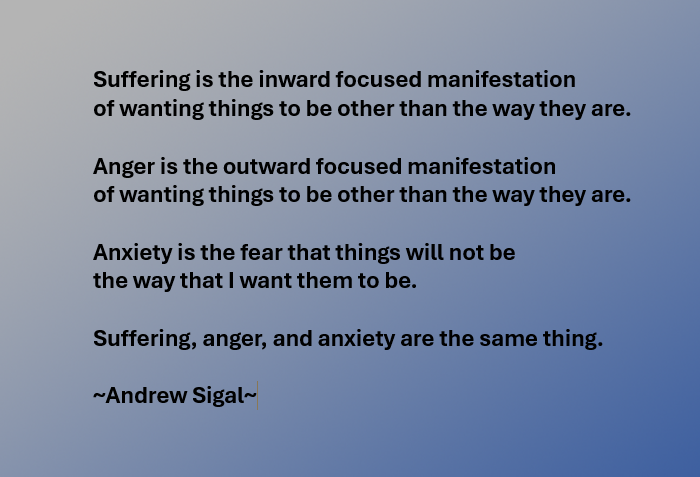
Suffering is the inward focused manifestation of wanting things to be other than the way they are.  Anger is the outward focused manifestation of wanting things to be other than the way they are.  Anxiety is the fear that things will not be the way that I want them to be. Suffering, anger, and anxiety are the same thing.

When asked what he teaches, the Buddha said, “I teach suffering and an end to suffering.” I have been learning for several years about the Buddhist conception of suffering (dukkha) and that it is caused by grasping and clinging. In Buddhist philosophy we seek an end to suffering through non-clinging.

A couple of years ago I started to feel that this didn’t quite match my view of suffering. I felt like there was a simpler way of looking at my lived experience. I concluded that, for me, suffering was caused by wanting things to be other than the way they are. Just that. Grasping is wanting that job, that spouse, that money, a child, a home, what that other person has, and so on. Clinging is wanting this person not to get sick and die, wanting not to get old and sick and die myself, wanting to keep this relationship, this job, this money, these things. But these are all, ultimately, just wanting things to be other than the way they are. That is all. This way of stating the idea works better for me.

Recently I had been faced with grasping and clinging in my life, causing suffering. I had also been experiencing a lot of anger. I took a trip to a place to relax. Upon arriving, I was faced with a series of annoyances. There was no mystery to this - I was primed to be annoyed and ready to be bothered by the slightest thing. I found myself so upset and angry that I wanted to just grab my bags, turn around, and leave. On the grounds there was a peaceful grove with a labyrinth. Instead of leaving, I went there and used the labyrinth for a walking meditation.

I had an extraordinary insight. I realized that suffering, and its shadow, sadness, are inward focused manifestations of wanting things to be other than the way they are. Anger is the outward focused manifestation of wanting things to be other than the way they are. This stopped me in my tracks. It was that simple. Suffering and anger are the same thing, it is only the direction in which they are focused that changes the experience. I stood there for some time, then continued my walk.

Later I was pulled up short by a third realization: anxiety is the fear that things will cease to be the way they are now (clinging), or that things will not become the way that I want them to be (grasping.) Suffering and anxiety are the same thing. They differ only in their time frame. Suffering is wanting things to be different than the way they are right now, while anxiety is the fear that things will be different than the way I want them to be in the future.

Suffering, anger, and anxiety are the same thing.

I have a friend who is dying. I am suffering now because I want her to not be old, sick, in pain, and in the process of dying. I am angry because I cannot change this. I am experiencing anxiety because I want her to not be dead in the future.

It is said that pain is inevitable, but suffering is optional. Now I see that it is also true that hurt is inevitable, but anger is optional, and that fear is inevitable, but anxiety is optional.
Suffering is the inward focused manifestation of wanting things to be other than the way they are.

Anger is the outward focused manifestation of wanting things to be other than the way they are.

Anxiety is the fear that things will not be the way that I want them to be.

Suffering, anger, and anxiety are the same thing.


Recently I attended a Buddhist meditation event. As part of the day there was a “dharma talk” – a talk about Buddhist philosophy. The talk was on impermanence (anicca), one of the three marks of existence (the other two, unsatisfactoriness or suffering (dukkha), and non-self (anattā), were touched on briefly.) 

The notion is that all things are impermanent, and that clinging to things (or grasping or thirsting) brings suffering. Accepting that everything is impermanent is necessary for bringing an end to dukkha.
After the formal talk, the speaker opened it up for discussion. There were a couple questions and comments, then I shared what was going through my mind. Sometimes things go badly in my life, or I am hurt or sad, and I “want my mommy.” My mother is still alive. I speak to her regularly on the phone. But “my mommy” doesn’t exist anymore. My mother is now the person that I take care of. She doesn’t take care of me. Our roles have reversed. I said that I find it strange to realize that I still have my mother, but my mommy is gone. My mommy was impermanent, and moreover, she was less permanent than my mother is.

I also spoke of how strange I find it that, once upon a time, I wanted to get up early on Sunday mornings to watch cartoons on TV. There used to be a “me” that watched The Flintstones, My Favorite Martian, Captain Kangaroo, and Mr. Roger’s Neighborhood. Now that person is gone. Where did he go? He was impermanent.

Thinking about it later, I realized that not only is the boy who watched cartoons gone, but that there have been version upon version of “me” that are gone. In a way, I have committed suicide over and over again. Each previous iteration of “me” was killed to allow for the next “me” to arise. The Hindu god Shiva dances the dance of creation and destruction, destroying the world so that it can be created anew. I am not the same person that I was as a child, nor the same person that I was in high school, nor the college student, nor 20 years ago, 10 years ago, nor even 5 years ago. Because of the health problems I have recently had, and the death of my father last year, I am not even the same person I was 18 months ago. I am impermanent.

People in the East seem to have less trouble with this idea than those of us in the West. In Japan, temples and shrines are periodically torn down and rebuilt from scratch. The Japanese will point to a temple and say that it is 800 years old, though it may have been torn down and rebuilt numerous times. A westerner would be likely to say that the temple now standing is a copy of the original – that it is only as old as its most recent rebuilding. So, what about me? Am I 57 years old, or 18 months old?

It is said that “you can never step in the same river twice.” Is this true? The molecules of water, the silt, the fish, the other chemicals and inhabitants of the river, move and change constantly. But what of the banks and bed of the river? From our viewpoint they stay pretty much the same from one moment to the next, changing only over longer periods of time. Is the “river” its bed and banks, or is it the water? Is the “river” actually our conception of “riverness”, rather than anything solid? Can we step in the same river twice?

What am I? Am I the container or the contents? Am I the river bed and banks or the water – or am I instead the concept of “Andrew”? Am I the constantly changing contents, or the slowly changing body, or some longer lived “Andrew-ness”?


Life is dukkha.
The hummingbird does not know this.
Oh to be a hummingbird.