Latest Posts


This afternoon I was taking an exit from the highway. It's a complicated exit with two lanes heading off in each of two different directions. At the last possible instant, a car in the extreme right lane suddenly veered to the far left. With some irritation I thought to myself, “You weren't paying attention, were you.” But then I changed mind. Maybe that wasn’t it at all.

Maybe they were on their way to a store to return something but suddenly realized they left the item on their kitchen counter. Maybe they had one of those, “oh crap, now I have to go back and get it”, moments. Or maybe, recently a loved one of theirs had died. They had planned to run an errand today, but as they were approaching the exit they decided that they just couldn't face the task, so they went back home instead. Maybe their GPS had told them to be in the right lane, then suddenly switched to take the other way for no apparent reason. I've certainly had that happen to me. Maybe they just got a text saying that their child was injured and they have to go to the hospital right now! Maybe they got a text saying that their spouse's water had just broken, so labor had begun, and the chore they were going to do before the baby's arrival had to go on the back burner. Or maybe they simply weren't paying attention. I've done that. Lost in thought, or talking with a passenger, or fiddling with the music in the car; I look up and realize I'm in the wrong lane. We've all done that, right? Or maybe they were just a bad driver; but being a bad driver doesn’t mean that someone is a bad person.

After I finished my exit and merged onto the next roadway, I spent the rest of my drive sending thoughts of love and kindness to the other drivers, regardless of how they were driving.

So now it's your turn; what reasons can you think of for the car in front of you suddenly doing something stupid in traffic. What rationales fill your heart with compassion and caring instead of irritation? Perhaps the next time you are on the highway you might like to send loving-kindness to the other drivers. I guarantee that there is someone on the road with you that could use a little love right now.

Someone once said that we sit on the (meditation) cushion, lifting light weights, so that when we are off of the cushion, in our regular lives, we will be strong enough to lift the heavy weights that life throws at us.

When I first heard that I liked it a lot. But I felt that it wasn’t quite right. I have decided that in fact it is sort of backwards. I say that when we sit on the cushion, we practice putting down light weights, so that when we are off the cushion, we know how to put down life's heavy weights.

In our lives we are handed heavy weights. These weights cause suffering. We hold onto these weights and carry them around. Often these weights are so heavy that we cannot bear them, and yet, we still don’t know how, or aren't willing, to put them down, to let them go.

In the quest for an end to suffering, we need to know how to set these weights down. On the cushion, we let go of the thoughts endlessly assaulting our minds. We are learning to put down light weights over and over again.

We need this practice because off the cushion, when we set heavy weights down, we often discover that we are somehow still holding them. We set them down over and over again, but they magically leap back into our hands, onto our shoulders, and onto our backs. Or, we don’t set them down at all. Though we can't bear to carry them, it can turn out to be harder still to let these things go, set them down, and walk away.

With practice setting down the light weights of the mind, we know how to recognize the heavy weights that we carry, and how to put them down, and put them down, and put them down again.

About a year ago I was carry a heavy weight of my own creation. This is when I began thinking about the role of meditation in letting go of the hardships that we seem to hold onto for dear life. At the time, this is what I wrote:

I'm holding a weight. It’s a very heavy weight. It's a very heavy weight, but I can’t get myself to let it go. It hurts. This weight hurts. If I just set it down, it won’t hurt so much. If I just set it down it will go away all on its own. The Buddha tells us that all things are impermanent, and this weight is impermanent, and it will go away all on its own. It will go away if I hold onto it, and it will go away if I set it down. But if I set it down, while it is going away, it won’t hurt. Or, at least, it won’t hurt so much.

I don’t have to throw it away, which is good because I’m not that strong. I'm not strong enough to throw this heavy weight, but I can put it down. I can put it down, and it will still be there; I can still look at it; I can see it and understand it and be with it; I won’t have abandoned it; but it won’t hurt as much.

I've lifted weights like this before. It was a long time ago, and the conditions and circumstances were different, and I was someone different. When I lifted this weight before, I hugged it to my chest. I hugged it to my chest, and I rocked back and forth, and it hurt. It hurt so much. It hurt so much that I couldn’t be in the world anymore. I had to leave the world for a while. I hugged that weight to my chest and I fed it. I fed it, and it bit into me, and it lasted, and it lasted, and it lasted as I protected it, as I held it in my arms, as I fed it. Ultimately it too was impermanent, as all things are impermanent. It went away, but if I had just set it down, it would have gone away much more quickly, and while it was going away it wouldn’t have hurt. It would have just been. It would have been a heavy weight that I had put down.

I am holding this heavy weight. I set it down. Now my arms are free to do other things. But then I pick it up again. I pick it up again, and it bites into me, and I hurt all over again. It’s not that I
can’t stop picking it up, it’s that I don’t stop picking it up. I’m not aware of picking it up, but I find myself holding it again.

Over the years I have held many heavy weights. When my dog died, when my father died, when my mother died. These were heavy weights that I held. These were heavy weights that hurt. But I learned to put them down. Not to throw them away. Not to hate them. Not to fear them. Just to set them down and let them be. Over time they went away, because they were impermanent.

So now I know how to set down a heavy weight. I put it down, and the relief is palpable, but then, hours or days later, I pick it up again.

I'm holding a weight. It’s a very heavy weight. It's a very heavy weight, but I can’t get myself to let it go.

And then I set it down.


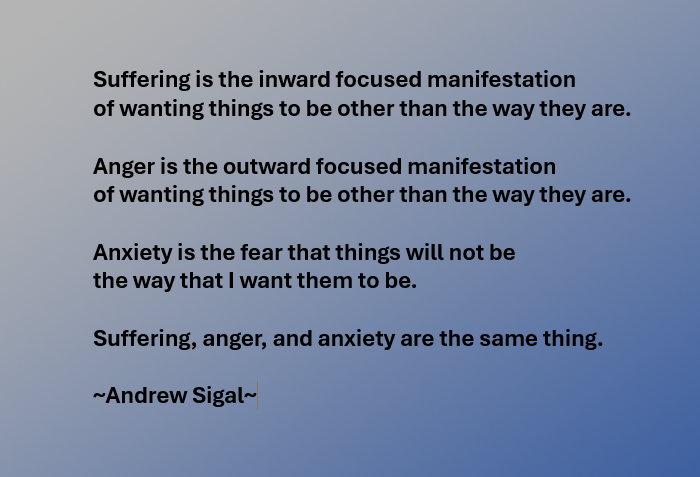
Suffering is the inward focused manifestation of wanting things to be other than the way they are.  Anger is the outward focused manifestation of wanting things to be other than the way they are.  Anxiety is the fear that things will not be the way that I want them to be. Suffering, anger, and anxiety are the same thing.

When asked what he teaches, the Buddha said, “I teach suffering and an end to suffering.” I have been learning for several years about the Buddhist conception of suffering (dukkha) and that it is caused by grasping and clinging. In Buddhist philosophy we seek an end to suffering through non-clinging.

A couple of years ago I started to feel that this didn’t quite match my view of suffering. I felt like there was a simpler way of looking at my lived experience. I concluded that, for me, suffering was caused by wanting things to be other than the way they are. Just that. Grasping is wanting that job, that spouse, that money, a child, a home, what that other person has, and so on. Clinging is wanting this person not to get sick and die, wanting not to get old and sick and die myself, wanting to keep this relationship, this job, this money, these things. But these are all, ultimately, just wanting things to be other than the way they are. That is all. This way of stating the idea works better for me.

Recently I had been faced with grasping and clinging in my life, causing suffering. I had also been experiencing a lot of anger. I took a trip to a place to relax. Upon arriving, I was faced with a series of annoyances. There was no mystery to this - I was primed to be annoyed and ready to be bothered by the slightest thing. I found myself so upset and angry that I wanted to just grab my bags, turn around, and leave. On the grounds there was a peaceful grove with a labyrinth. Instead of leaving, I went there and used the labyrinth for a walking meditation.

I had an extraordinary insight. I realized that suffering, and its shadow, sadness, are inward focused manifestations of wanting things to be other than the way they are. Anger is the outward focused manifestation of wanting things to be other than the way they are. This stopped me in my tracks. It was that simple. Suffering and anger are the same thing, it is only the direction in which they are focused that changes the experience. I stood there for some time, then continued my walk.

Later I was pulled up short by a third realization: anxiety is the fear that things will cease to be the way they are now (clinging), or that things will not become the way that I want them to be (grasping.) Suffering and anxiety are the same thing. They differ only in their time frame. Suffering is wanting things to be different than the way they are right now, while anxiety is the fear that things will be different than the way I want them to be in the future.

Suffering, anger, and anxiety are the same thing.

I have a friend who is dying. I am suffering now because I want her to not be old, sick, in pain, and in the process of dying. I am angry because I cannot change this. I am experiencing anxiety because I want her to not be dead in the future.

It is said that pain is inevitable, but suffering is optional. Now I see that it is also true that hurt is inevitable, but anger is optional, and that fear is inevitable, but anxiety is optional.
Suffering is the inward focused manifestation of wanting things to be other than the way they are.

Anger is the outward focused manifestation of wanting things to be other than the way they are.

Anxiety is the fear that things will not be the way that I want them to be.

Suffering, anger, and anxiety are the same thing.


I have been growing Australian finger limes (Citrus australasica) for a dozen years now. The thing that is cool about finger limes is that when you cut them open, little balls of lime juice spill out. They are about the size of flying fish row (aka tobiko) and are sometimes referred to as “lime caviar”. Unfortunately, there aren’t many applications for them. Back in 2021 I concluded that marmalade could take advantage of the special characteristics of finger limes. The result was not great. Primarily, the flavor was too bitter for most uses. Three years later I still haven’t used up all of that marmalade. Moreover, it took much too much effort to make. You can read all about that experiment here if you are interested. Note that I have left out many details here, since much of it would be redundant with that original posting.

I have been harvesting, collecting, and freezing finger limes ever since, intending to try again and see if I could get a better result. Finally this fall I made a batch, changing a number of critical steps in the process.

The verdict? The new batch is much sweeter, less bitter, and easier to prepare. However, I still wouldn’t say it was great, and it is still a lot of work. Nonetheless, here is the recipe from my recent attempt. Perhaps with yet more work it could be turned into a useful recipe. Your mileage may vary.

Note: for the purpose of incorporation into a cooked product like marmalade, these limes freeze well. In fact, they freeze surprisingly well to store for almost any application. This batch included 100% frozen fruit collected over the course of 2024.


Australian Finger Lime Marmalade Recipe v2.0
Yield: 9.5 cups

Ingredients:
3.5lbs Finger limes
2.25lbs Sugar for macerating limes (equal to the weight of processed limes)
Additional 12oz sugar (added during cooking)
¼ C Karo syrup (to reduce sugaring off)
1 pkg liquid pectin (3oz)
1 tsp Kosher salt

Note that last time I added baking soda, which can be helpful with marmalade to soften the skins. However, finger lime skins are already thin, and baking soda is bitter, so I left it out this time. There was no issue with the skins being tough.

Method:
Processing the limes took a huge amount of time and effort, so as before, I did it in two batches over two days, then cooked them on the third day. I don’t think it is necessary, though when making marmalade, macerating the fruit in sugar is generally a good idea to get it to release liquid and pre-absorb sugar. On the first day I processed about 1.5 pounds and macerated the “pearls” in the refrigerator with an equal amount of sugar. On the second day I processed the rest, adding them to the same container, again with an equal amount of sugar. I stored the skins separately. On the third day I assembled and cooked the marmalade.

Processing the limes:
(1) Wash and dry the limes.

(2) Slice the stem end from each lime. Squeeze the fruit from the skins with a small rolling pin. A wooden “cocktail muddler” with a straight handle worked well for this.


(3) Previously I had removed the seeds at this point. It was an unbelievable pain in the ass and took a ridiculous amount of time. For this version I left the seeds in with the fruit, since they float to the top during cooking. However, it turned out that skimming them from the surface during cooking was a huge pain in the ass and took a ridiculous amount of time!!! Oh well. [A reader suggested scraping the lime pearls from the skin under water, and then skimming the seeds as they float to the top of the water. If I do this again, I will try it – though I have to wonder about the amount of lime juice from popped pearls that will be lost.]

(4) I discarded ½ of the skins (by weight.) The remainder I blanched once in water for 3 minutes to reduce the bitterness. [The same reader noted that they retain all of the skins, but simmer them in water for 1 hour - twice! I am sure that would eliminate all bitterness but might lose a lot of the flavor, texture, and interest of the skin as well.]

(5) Chop the skins into pieces of a size that is pleasing to you. This time I chopped them more thoroughly than I wish I had. They lost a lot of toothsome character. I need to try to find some reasonable way to cut them into disks or strips.

Cooking the marmalade:
I recommend investing in a copper jam pot if you do a lot of preserving. They are quite expensive (generally US$200 and up), however, using one makes preserving easier and produces a better product.

Before starting, put a plate in the freezer with some spoons to use in testing for setting.

Put the macerated limes into the pot along with 12 oz additional sugar and 1 tsp Kosher salt.

Bring to a full boil over medium-high heat. Reduce the heat and simmer for about 20 minutes, stirring occasionally. Assuming you have not removed the seeds previously, attempt to skim off the seeds from the surface. I started using a spoon, but that was insanely inefficient. I then switched to skimming with a very small sieve. There was a fair bit of lost fruit using this method, it was a long, slow process, and I ultimately only got about 90% of the seeds out. Oh well.

Return the mixture to a full rolling boil over medium-high heat, stirring constantly. Stir in the liquid pectin. Return the mixture to a full rolling boil, stirring constantly. Boil for one minute or so. Note that using liquid pectin the marmalade gels very quickly.

Test for setting using a spoon from the freezer (or any other method you prefer.) When the marmalade has set to your satisfaction, remove it from the heat. Allow it to cool for a few minutes to minimize separation of the fruit, skins, and juice. However, don’t let it cool too much or it will be impossible to fill your jars.

Ladle into sterilized jars and process by whichever safe preserving method you prefer.


Some weeks ago, I was at the San Francisco Museum of Modern Art (SFMoMA) with friends. Among other things we stumbled into a video installation by Icelandic artist Ragnar Kjartansson entitled "The Visitors". I was blown away. It is a large space with nine screens, showing views into eight different rooms in a house, plus the front porch. There is a musician in each room. They are playing a song together, but also apart, in their separate rooms. Each display has its own speaker. Walking around the space you hear the music changing as though you were moving through the house. From the center you hear all of the performers in balance.

Viewing it in its entirety is problematic. It is 64 minutes long, so unless you have planned this into your day, it is a challenge. When we first went in, we only caught the last few minutes. Later we came back and saw another portion (the video runs continuously in a loop.) I felt that I had to return another time to see it all the way through.

Last week I got my chance. I was in San Francisco for an appointment, so afterwards I went to SFMoMA. I asked at the ticket counter what the schedule was for The Visitors. It turned out that there was about 45 minutes before the loop was scheduled to restart. I wandered through exhibits until the next start-time, then returned to the installation.

I experienced The Visitors from the beginning, with all the screens blank, through to the end when they each return to darkness. It was spectacular. I am sure it is not for everyone, but for me it was magic. I felt an indescribable sense of peace after I left the room. I was just happy in a remarkably simple, inexplicable, unadorned way. 

The song that they are playing has a short lyric that is repeated in various ways throughout the "performance", mostly repeating the line, "Once again I fall into my feminine ways." Over time, the music is played on different instruments, usually rather softly but sometimes with a loud intensity. The lyrics are somewhat somber, but it isn't saddening - it is mesmerizing and compelling. I would say that none of the musicians are great singers, but their song and music feel heartfelt and genuine, made all the more so by our being invited into a seemingly intimate performance. There are also touching moments when one musician leaves their room, walking to another space to join another performer, expressing a connection physically that hints at the musical interaction, then returns to their own room and their own instruments.
 
Unfortunately, try as I might, it is one of those things that really can’t be described in words. Even if one were to view it online - there are versions on YouTube - you still wouldn’t be able to really get it. I took a brief video to try to capture at least a vague sense of being in the space: 


It is probably not everyone's cup of tea. But, if you want to see it, it is at SFMoMA through 11/13/24. They start the loop 15 minutes after the museum opens, repeating every 64 minutes throughout the day. The installation can be found on the sixth floor. Paid admission to the museum is required, but there is no additional ticket needed for The Visitors.

It is also possible that you might see it elsewhere; apparently it has been shown in various museums on and off for over a decade. However, I have not been able to find any kind of calendar indicating where the installation might be going in the future.

If you've seen it, or you go to see it, I'd love to hear what you thought.

[FYI, the man playing acoustic guitar in the bathtub is Ragnar Kjartansson.]
[FYI2, caution: the song that is performed can become quite an earworm.]
[FYI3, after The Visitors, I went down to the front lobby of the museum on the first floor, lay in a huge memory-foam bean-bag chair, and watched the giant display showing slowly moving graphics of oceanic things floating around. A lovely re-entry into the world before leaving the building.]

Shakespeare famously wrote in As You Like It, "All the world’s a stage, and all the men and women merely players..." So famously, in fact, that to quote it can often seem trite. All the world may well be a stage, but in As You Like It, Shakespeare makes no mention of the viewers of our performance.

I often wonder about an imaginary audience for my life. I wonder what my audience knows that I don't know. When watching a movie or play, we might see the protagonist about to make a blunder, or after making a mistake that they don't even realize, or looking under the bed when they really should have walked away. We, the audience, often know things that Shakespeare's players don't.

Sometimes we wince as we watch, because the awful scene that is unfolding wouldn't have happened if only the characters were aware of some hidden fact that the author has clued us into. Oh, if only she knew that he secretly loves her; if only the platoon knew that the seemingly peaceful field is a trap; if only the ensign wearing the red shirt knew that it is always the red shirt crewperson that dies a horrible death right after transporting down to the planet from the Starship Enterprise.

What does my audience know? If I could ask them, what would they tell me? What blunders am I making? What should I realize that I don't. What am I missing? What am I forgetting? What do I think is important, but is actually irrelevant? What critical detail did I miss?

Is my audience wincing as they watch me go through my life? Do they wish that they could reach through the screen, grab my collar and yell... something. Something vital. Something that would make my life right now so much better; something that could save me, or a friend, or a loved-one from a terrible future. Or, if not a terrible future, possibly just a disappointing one. When the play is over will my audience leave the theater thinking, "that Andrew character made some pretty bonehead mistakes", or perhaps, "what a pity, I expected so much more."


I often find lessons in the Dhamma (better known to Americans as the Sanskrit word pronounced “Dharma”) while driving. The other day I found Dhamma as a pedestrian crossing the street.

Last week Richard Shankman, the leader of my meditation group, gave a talk on the Buddhist ideal of metta, usually translated as “Loving Kindness”. He said that it is his goal to always have an open heart; to never close off his heart to anyone.

The next day I was walking in downtown Oakland, CA, when I came to an intersection. The light was against me so I had to wait to cross. Just as the light changed and I stepped off the curb, a large van at the far side of the street attempted to make a right turn on red, but was stopped by oncoming traffic. This left the unusually long van blocking the crosswalk.

I felt annoyed that I was going to have to go around this obstacle. My first thought was “what a jerk.” But almost immediately I stopped myself. I thought, “I’ve done that.” I never try to end up blocking a crosswalk while driving, but sometimes it happens anyway, through error or misjudging the traffic conditions. As I was walking around the van, a trivial extra effort, I thought, "I don’t know anything about this driver." Perhaps they strive to always be as courteous as possible. Perhaps blocking the crosswalk this afternoon was something they virtually never do. Maybe they were sitting in the van feeling incredibly embarrassed at having screwed up and blocked my way.

I realized I had no way of knowing if the driver even owned that vehicle. Maybe they had just gotten it, or rented it, or had been directed to drive it by an employer. Maybe unfamiliarity with the van caused them to drive it poorly. 

Maybe they tried to make that right turn on red because they were in a genuine hurry for some reason. I was near the hospital district, so possibly the van was full of medicines or medical equipment needed quickly at a doctor’s office. Perhaps they had learned that a friend had been hurt and so they were rushing to get to the hospital to be with someone that needed them.

Or maybe the driver was a jerk. Maybe they did this all the time. Maybe they really didn’t care about pedestrians or other drivers. 

Either way, I didn’t know. I couldn’t know. So instead of feeling anger or annoyance, instead of judging this person, I opened my heart to them.

I am no saint and I'm certainly not a Buddha. I am a work in progress. I can only hope to be as I was that afternoon, opening my heart more often in more situations, and finding the Dhamma everywhere.
"Shower" by Kevin Dooley is licensed under CC BY 2.0.

When I am in my shower, I try to be aware of gratitude. I love showering. I love the sound of the water and the way it blocks out other sounds, the feeling as it hits my skin, the temperature, the humidity, the feeling of being cocooned in this space. When I was fortunate enough to be able to design and build my house, I created a beautiful bathroom with a great shower. I am grateful for my shower.

I try to remember that what I have is extraordinary. I am able to shower every day. I can take a nice, long, hot shower. I can shower simply because I want to even if I don’t really “need” to. These facts are incredible. This is an amazing gift I give to myself. This is an astonishing opportunity that I have. And this is something that I always remember is rare indeed.

I live in a time and place where the municipality provides clean, safe water directly to my house, and utility companies deliver the energy needed to warm that water to whatever temperature I desire. A thousand years ago only a few hundred people in the world would have been able to access an effectively unlimited supply of hot, fresh water, and fewer still would have been able to indulge themselves in this way with any frequency. But even today, in most parts of the world, it is only the wealthiest individuals that can indulge such pleasures. For most people in most places around the world and across all of time, enjoying a shower would be unimaginable decadence.

Indeed, the access to clean, safe, reliable water in any form for most of humanity is something to be prayed for – I flush such water down the toilet. It is not lost on me that someday the drought in the western United States, exacerbated by climate change, will cause the water to run out, or my health will run out, or this space will be gone… someday this will be just a memory of a sweet, long-lost time. This is something that I appreciate when I am in the shower.

It is not lost on me that I have such wealth that I was able to create this space, and to purchase water and fuel. It is not lost on me that I have the freedom to choose to live in a place where clean water is delivered to my home. It is not lost on me that California is in a drought and that should the water stop, I can choose to move. It is not lost on me that I have the time to enjoy this.

I also do not take for granted the fact that I am able to shower without assistance. In her later days, my mother loved Thursday, because that was the day that her caregiver helped her to take a shower. She couldn’t undress herself alone, nor safely get into or out of the shower. She certainly couldn’t control her body sufficiently to wash her hair. I think of Senator John McCain, who, due to torture in Viet Nam, could not lift his arms over his head. Did he have to rely on others to wash his hair for him? I am aware of those in wheelchairs, paraplegics, and quadriplegics, for whom showering is likely a lengthy and involved process and may be impossible without assistance.

For myself, there was a time, not long ago, when due to medical devices attached to my body, I had to prepare myself for a shower. I had to wrap my arm in plastic wrap and tape it in place to keep my arm dry, and I had to keep my showering brief to reduce the risk of water getting under the wrapping. For a while I needed someone to help me wrap my arm, and then to unwrap it afterwards. Washing my hair alone was challenging because of limited mobility. If I could wash my hair at all, it was only with one arm. What a gift that taking a shower no longer requires any preparation beyond disrobing, and I need to do nothing more than dry off and dress afterwards.

I indulge myself in these moments of peace and beauty, knowing that just a few miles from my shower there are people living in tent camps. I don’t know how they bathe themselves. I don’t know how far they must travel, nor what they have to do to get to any kind of washing facilities at all. I indulge myself, well aware of the fact that there are uncounted millions around the world without access to safe drinking water, let alone a shower.

Sometimes these thoughts make me sad, so I cut my showering short. But more often I just try to appreciate this amazing experience, this incredible experience, this rare, unique, gift of an experience.

Forgive me for waxing poetical about the joys of showering. But I encourage all to find something in your life that you are taking for granted and to instead give it the attention that it deserves.

Afterword:

When I was a child, Thanksgiving meant a day off from school and a big, delicious meal prepared by my mother. Later on, living on my own, invited to friends’ houses for Thanksgiving, I was introduced to the ritual of each person at the table saying what they were thankful for. We had never done that in my family so I thought it was silly, but being a good guest, I went along with it, coming up with some statement of thankfulness. Now that I am older, with the perspective provided by time, and experience, and loss, and pain, I try to be thankful every day for all the great gifts that I have received. I am so very grateful for friends, and health, and food, and freedom, and among the many, many fortunes that I have, I am grateful for my shower.

I wonder if caterpillars know that they will become butterflies. When a caterpillar on a leaf sees a butterfly flying around, does it think, “that will be me some day”? Or perhaps, “I hope I become a butterfly like that one.” Or does it just see butterflies as another of the many things in its universe? Can a caterpillar, in its limited capacity, even conceive of a relationship between itself and a butterfly?

I wonder if butterflies know that they were caterpillars. When they are drinking nectar from a flower and notice a caterpillar on a leaf, do they reminisce about those bygone days? Do they think caterpillars are cute? Do they look forward to laying eggs, or fertilizing eggs, that will become caterpillars?

I wonder if we are the larval form of something else… some next existence of which we cannot conceive. Butterflies aren’t just caterpillars with wings glued on. So, rather than floating around on clouds in heaven in humanesque bodies with wings, perhaps we become something inconceivable. In our extraordinary capacities, we can imagine quite a lot. But I wonder if there might be an afterlife after all – merely one that even we cannot conceive.

What do caterpillars think of their lives? I doubt that caterpillars have existential crises in which they wonder about the meaning of their existence. But if they did, would knowing that they are larval butterflies make them feel any better? Would that give them a sense of purpose? Meanwhile, who is to say that being a butterfly is any better than being a caterpillar. From our human aesthetic, butterflies are pretty, and airborne, and visit flowers, while caterpillars are usually more drab, climb on plants, and eat leaves. But perhaps being a caterpillar is an idyllic carefree childhood, while being a butterfly is an anxiety-filled adulthood, desperately trying to reproduce.

This human life seems rather pointless, but maybe we are larval stages of something else. Would knowing that make this life feel more purposeful? Do metamorphosized “people” look at humans with any recognition of a connection? And if there is some next existence, who’s to say if this life is idyllic childhood, or if that next life is beatific flitting from flower to flower.


I have heard it said that to name something is to destroy it. Once it is named, the thing that is right in front of you is then just an example of “one of those”, and you no longer see the thing itself.

I was reminded of this idea this morning. There was a rainbow over Oakland. I counted off the colors: ROYGBIV - Red, Orange, Yellow, Green, Blue, Indigo, Violet. Then I looked to see where the sun was. I noted that it was in the east and the rainbow was to the west, just the way the science of physics tells us it will be.

In looking at the rainbow, I realized that I wasn’t seeing it as a beautiful phenomenon. I was seeing it as an artifact of atmospheric conditions and the mechanics of light. Like knowing how a trick is done, or the answer to a riddle, or that at the end of the movie the universe is saved but the hero dies, knowing how a rainbow works takes away the magic.

Perhaps physics classes should come with a warning: “Spoiler alert.” Now it is up to me to put knowledge aside and see the rainbow as beautiful again.


Riding home on the Bay Area Rapid Transit (BART) last night I felt so lonely. Everyone on the train was somewhere else. Most people had some kind of earbuds or headphones on, and almost everyone was looking at their cell phones.

I was listening to music on my phone with my earbuds and really rather enjoying it. But when a person sat down next to me, I realized that they weren't really there. It wasn't just, "sitting next to someone I don't know"; it was sitting next to someone that wasn't sitting next to me at all.

So, I took out my earbuds and put away my phone. I wanted to connect in even the most trivial of ways.

I noticed another man, of about my age, on the train. He didn't have anything on his ears, nor was he holding a phone. He was behind me, so I had to turn pretty obviously to look at him. He didn't look back. I wanted to signal to him in some way that we were kind of kindred spirits, but, of course, we were strangers on a train, and I was a stranger craning around to look at him.

I thought about when the Sony Walkman came out. The "older generation" decried it as the end to sociability. Perhaps it was the first drop in the bucket, the first chip in the glass, the first step on the journey to isolation.

The difference is that now many of the people on the train probably are being social - it is likely that they are on their phones using social media or doing email. They're just not being social with those humans around them. They aren't isolated from those nearby by music on a Walkman, they are somewhere else, with someone else, as I sat alone on the train.


The 4th of July occurred (inconveniently) on a Tuesday this year (2023). This got me thinking about US holidays which are fixed to a certain date in the year, vs. those that are (currently) always celebrated on a Monday.

We have New Years Day, which is always January 1; "The 4th of July", always celebrated on July 4; Christmas is December 25th; and most recently Juneteenth, which is June 19. [Note that for the US Federal Government, and many businesses, if one of these dates falls on a weekend it is then "observed" on either the preceding Friday or the following Monday.]

Then we have the so called "Monday holidays", which occur on different dates each year, corresponding to a Monday (though some of them used to be holidays fixed to a date): Martin Luther King Day, President's Day, Memorial Day, Labor Day, etc.

Lastly, we have the oddity of Thanksgiving, which is observed on the 4th Thursday in November - so the date floats, but it is always a Thursday.

I can't help thinking that if we just called this holiday by its proper name, "Independence Day", it could be turned into a Monday holiday. It is only fixed to a specific date because it is commonly referred to as "The 4th of July".

Independence Day is particularly ripe for becoming a floating holiday because it isn't even clear that July 4, 1776, is the most significant date in relation to the Independence of the United States from Great Britain. After all, the declaration was ratified by Congress on July 2, 1776, and the "official" copy on display at the National Archives was signed (primarily) on August 2. Meanwhile, the war with Britain began in April 1775, more than a year before the declaration was ratified let alone signed. The war wasn't officially over until the signing of the Treaty of Paris, September 3, 1783. Arguably, independence wasn't assured until that happened.

Moreover, "The 4th of July" tells us nothing about what we are celebrating. The holiday is intended to commemorate the anniversary of the colonies making up the "United States" declaring independence from Great Britain. Calling the holiday by its true name makes it much more meaningful than simply referring to the date in July on which we have chosen to commemorate it. Celebrating July 4, by that name, makes no more sense than celebrating any other date on the calendar.

So, we really ought to refer to this holiday as "Independence Day" and celebrate it on the first Monday in July, regardless of the calendar date on which that Monday happens to fall.

Just my 2 cents.

My sister Erica Sigal and I are proud to announce the creation of an endowment at the Arnold Arboretum of Harvard University in memory of our mother. This endowment, the Elise C. Sigal Research and Education Fund, will be used by the Arboretum to promote research and education about the plant kingdom, particularly in the fields of horticulture, arboriculture, and botany.

We are creating this fund today, on what would have been our mother’s 90th birthday, to honor her love of horticulture and of the Arnold Arboretum, where she was a volunteer for over 40 years.

We hope that this fund will help students and researchers to learn about and advance our knowledge of the plant kingdom and that it will do so for generations to come.

Here in my part of the United States we experienced the switch to Daylight Savings Time last night. That is to say, we transitioned from “Standard Time” to “Daylight Time”. I live in California, so that means going from Pacific Standard Time (PST) to Pacific Daylight Time (PDT). I hate the daylight savings time switch. I have always hated daylight savings time whether we were moving our clocks forward in the spring, or back in the fall. I used to say that it was like getting jetlag without the benefit of going anywhere. This morning, as I lay in bed, I realized that that little joke obscured the true reason why I find this time change so unpleasant.

I was thinking about what it would be like if we hadn’t gone to daylight time last night, but instead, I had taken a red-eye flight to somewhere one time zone to the east. For me that could mean flying from San Francisco to Denver. When I landed in Denver I would have reset my watch to one hour later – ugh. But the transition to DST is worse than that. Why? Is it just because I am now in Denver and able to visit friends and see and do things that I cant do back home? That is what I used to think, but that is not the real reason.

I realized that at any given moment there are three kinds of time going on that are relevant to my normal life. There is what I call “clock time”, the time displayed on a clock, there is “solar time”, the place where the sun is in the sky (which is the time that would be displayed on a sundial), and there is “circadian time”, the time that it subjectively feels like to my body.

If I flew from San Francisco to Denver I would experience jetlag because my circadian time would be out of sync with clock time. But it wouldn’t be that bad because the local clock time and solar time would be in sync. For me the sun would rise and set 23 hours after the last time I had seen it rise and set. My body would adapt relatively quickly, taking its cue from the sun, causing my circadian time to come into alignment with both the local solar time and clock time.

The transition from PST to PDT is much worse than that. This is because the morning after the switch both my circadian time and solar time would be out of sync with clock time. The clock would tell me that the sun rose 23 hours after the prior sunrise. But that wouldn’t be true. I would experience (approximately) 24 hours between sunrise on the morning before the switchover and the morning after the time change.

At this time of year in California, the sun rises 1 or 2 minutes earlier each day (because of elliptical orbits and the tilt of the earth’s axis, the change in time of sunrise from one day to the next is not constant.) That means that it will be April 24th before the solar time and the new DST clock time are back in sync again. My body is able to adjust to the daily 1 or 2 minute change in solar time that occurs throughout the year without my even noticing it. My body is able to adjust to travel between time zones because the solar time in the new time zone corresponds to the local clock time, helping me correct my circadian clock. But I have a terrible time with the daylight savings time change because only the clock time has changed – my circadian time and the solar time are both out of sync with what the government tells me the time is now.


My mother with a friend's dog, Harry


Dear Mom,

There are so many things that I want to tell you, but I can’t make it through telling you these things in person. So, I have written them down and asked your caregiver to read this to you.

I wanted to tell you how much I love you. How terribly important you have been to me throughout my life. How much of you is in me. How much you have made me who I am. I am the child of both you and dad, but I wanted to make sure that you know how much I cherish those aspects of myself which came from you. More than anything the kindness and caring, but also your love of knowledge, your breadth of interests, and your sense of humor, subtle and ironic.

Did you know that for me, every dinner was a conversation about nurturing and love? That I had watched the hours of effort you put in and the stress you endured when dad was on his way home amid the rush to get dinner ready on time. His entrance demanding, “when’s dinner!” was made all the more painful because I had been watching you working. I was sitting in the kitchen, watching TV, but you were at the stove just beyond the TV, so I was watching you too. This was a conversation in which dad did not participate, spoken in a language which he did not appear to understand. He sat down at the dinner table, ate, and then left. The love and nurturing were between us. Of course, I didn’t understand this ‘till many years later. It was only in my late 20’s that I began to figure this out, and later still that I felt I understood how food represented to me love, caring, and compassion.

For my whole life I have never understood the word “milquetoast” (a timid or feeble person), because to me, “milk toast” was one of the things that you gave to someone you cared about when they were sick. Milk toast, bananas, apple sauce, and love. So too I find the term “mamas’ boy” absurd, defined as “a boy or man who is excessively influenced by or attached to his mother.” How could being attached to or influenced by one’s mother ever be excessive.

I remember tiny little things from growing up. I remember you at the kitchen sink, doing dishes, and then hitting Spot on the back with a fork when he bit Seymour for stealing his food. I remember you closing the window at the bottom of the stairs at the house on North Street, telling me that if cold air blew over your chest you would get a cold. I remember that you could never get a blueberry pie to set up, so you called it “blueberry pie soup.” I remember lying on the couch in the living room at North Street after coming home from school with what turned out to be a fractured arm, and the concerned look on your face when I slept through that whole day.

I remember losing my shoe in mud on a beach in Canada, and you trying to wash me off in water that turned out to be electric due to a downed power cable. I remember stepping into an elevator, thinking that you were behind me, only to discover when the doors had closed that I was alone.

I remember gerbils in terrariums in the room between the kitchen and the garage. I remember hatching chickens in an incubator in the kitchen. I remember taking your wristwatch apart, but not being able to put it back together. You didn’t scold me. I remember you driving me and some other kids to day-camp. I remember making paintings by blowing paint over sheets of paper with straws.

I remember you letting me stay home from school when I was “sick”, even though I was clearly faking it. I remember going with you to the Cambridge Center for Adult Education – you took classes in paper sculpture, and flower arranging, and stained glass, and jewelry making, and mosaics. I remember talking you into buying things for me: a block of balsa wood at Ken-Kay-Krafts, and endless bottles of Testor’s paints for model cars and planes; cactus and other plants that ultimately you had to take care of; raspberry-lime rickeys from Brigham’s. I remember you buying me marbles and maple syrup candy somewhere – maybe it was the Salem Witch House?

I remember watching the first moon landing from your and dad’s bed. And Thalassa Cruso’s Making Things Grow, and The Galloping Gourmet too. I remember watching endless hours of cartoons in the kitchen while you made dinner at night, or breakfast on Sunday morning.

I remember a piece of cardboard with coins taped onto it which you used to teach us about money. I remember you typing my school papers for me because I had left my assignment till the last minute and didn’t have time to type it myself. I remember dad complaining that you walked too slowly and having to choose between keeping up with him or hanging back to walk with you.

I remember calling you from the bed in my hospital room after my heart-attack - asking you to come out to be with me, even though I knew you hated travel.

I remember shopping trips to the kitchen supply store on Newbury Street, and Mass Hardware, and I remember hiding in the middle of the round racks of clothing at Jordan Marsh while you shopped. I remember your driving what seemed at the time to be a ridiculous distance to Waltham to buy bread, or to get pizza at the really good place that was worth the long drive.

I remember the vegetable garden on the far side of the garage at North Street. I remember somewhere getting the plant growth hormone called gibberellic acid. I wanted to see what would happen if I injected it into plants instead of putting it on the leaves as you were supposed to do. For some reason you let me try it. I remember making Halloween costumes from sheets, and carving pumpkins – wondering if some day my pumpkins would come out as well as yours (they never have.)

I remember you bathing me in the bathtub in the new bathroom at North Street after the renovation, and I remember the old, long bathroom from before the renovation. I feel like I remember the changing table in that old bathroom, but I am sure that must be a false memory. Was the room light yellow? Was there a window at the end of the room? Were there sheer curtains with embroidered flowers on them? That is how I remember it, but it is likely to be something part remembered, and part imagined.

I have travelled an unorthodox path through my life; taking years to get through college, not marrying nor having children, leaving my career at its peak to go off and have fun. But I hope that I have made you proud. I hope that I didn’t cause you too much grief along the way.

You said to me recently that you don’t want to be an “inconvenience” or a “bother”. You took care of me my entire life. That is something that I can never repay, nor do I want to repay it. This is not about reciprocity. This is about love. There is no inconvenience. There is no bother. My only wish is that you be as comfortable as possible.

I want you to live forever, but no one does, and “death comes to us all.” I want you to know that I understand. That you did everything you were supposed to do, and you did it so well. I understand that you have to leave.

I want you to know that you should feel completely free stay as long as you want, but also to leave whenever you need to, whenever you want to. I will cry for a long time, but that too is inevitable – that is the inevitable consequence of your being such a great mother, such a great person, and such a deeply caring caregiver to me all of my life. You have done everything necessary to make me the man that I am today, able to stand on my own, able to care for you now, and able to survive after you are gone. Please stay, if you want to stay, but don’t stay because of me. Go when you are ready. There is nothing you need to worry about. Erica and I will take care of everything.

And I will always love you.


 Elise Cunin Sigal, my beloved mother

1933-2022


Elise C. Sigal, 89, of Oakland, CA and formerly of Newton, MA, passed away peacefully on Monday, October 30, 2022, surrounded by her children. For 63 years the beloved wife of the late Marlowe A. Sigal. Devoted mother of Erica Sigal and Andrew Sigal.


Born in Bath, PA, and raised in Allentown, PA, Elise spent most of her adult life in Boston and Newton, MA, before moving to Oakland, CA, to be close to her children. She graduated from Brandeis University with a degree in music history.


Elise was an avid gardener; she turned her especial love of trees into a volunteer position at Harvard’s Arnold Arboretum, assisting in a variety of roles for over two decades, ultimately running their plant information phone line. She was an active participant in the Newton community. She worked with the Newton Creative Arts Committee where she served for a time as Chairperson. 


She shared her late husband’s passion for early music, antiques, and historic homes, frequently attending performances and museums. Elise also hosted visits to her home by musicians and early music organizations. 


She is missed by all those whose lives she touched.


In lieu of flowers, the family asks that remembrances be made to the Cunin/Sigal Research Award Endowment at the Arnold Arboretum, Boston, MA or the Elise C. Sigal Musical Education Fund at the Sigal Music Museum, Greenville, SC.


In the nearby city of Albany, California, there is an old landfill which is now generally known as the “Albany Bulb”, or just "The Bulb." Over the years it has been a landfill, a dump, an encampment for homeless residents, and a park, as well as being a canvas for some extraordinary art (more at AlbanyBulb.org)

In October 2019 I was walking one of my favorite loops at the Bulb. On the return leg, I saw writing spray painted along the edge of the paved path. I read it as I walked. I was stunned. I was touched. In fact, I was so gobsmacked that I had gone on at least another hundred feet before I realized that I had to go back to the beginning to record this message before it disappeared, as is the fate of so much of the ephemeral art created at there.


I have transcribed the text here, primarily so that search engines will index it, should anyone be looking for it. I have attempted to retain case, punctuation, and spelling, even when it is technically incorrect. This is, after all, a cry in the wilderness, not an essay for a picky college English teacher, and I feel that hand of the author reveals something of what they are trying to express to the world.
OK, so, one time you, yes you and I got high here. You told me that every thing was going to be OK. For the most PART it has been. But you died 3 weeks AGO AND I MISS YOU. Hope youre doing well. Call me if you need anything, though you left, im still here… Anyways. i have to go now. Don’t forget about me Please… good night, sweet dreams
I have no idea who the author was. I don’t know if this was created by a writer, or a poet, or an artist who regularly paints messages in public places, or, as I suspect, if they are the words of someone who truly had recently lost an important person in their life.

In any case, for me it evokes sadness, but also either bewilderment, or naivete, or extraordinary faith. The author is speaking to their lost companion as though they were right there, as though their friend can hear them and can even respond. Either this person is naïve (in a very touching way) as to what death really is, or has such deep faith in an afterlife that they truly believe their friend is right there, listening, and might even need something from them, or, as I believe is most likely, they are so lost that they cannot accept the fact that their friend is gone. I wonder about their fear that their friend might forget them – perhaps it is a reflection of their own fear that they may forget the one that is gone.

This video still makes me sad when I watch it, even years later. I hope that for this anonymous writer, everything has been OK.

Ribbon Cutting

In mid-2019 the Carolina Music Museum was renamed as the Sigal Music Museum in honor of my father, and in recognition of the gift of his collection to the museum. We have been trying to have a renaming ceremony ever since, but COVID has forced it to be delayed several times. Finally, on April 22, 2022, we were able to have the event, at which I was honored to speak and cut the ribbon for the opening. [For more on the Sigal Music Museum, see my prior post about it The Uncarved Block: the Sigal Music Museum]

I have been asked for a copy of my remarks, which I present here.

----------------------------------------------------------------------------
Good evening.

Thank you all for coming. I can’t tell you how excited, happy, and proud I am to be here today.

I suspect that only a few of you know the story of how my father’s collection made its way from Boston to its beautiful new home here in Greenville.

My father had been collecting musical instruments for decades. From time to time he would consider the question of what he wanted to have happen to them after he died – and then he wouldn’t do anything about it. Occasionally someone from one institution or another would approach him about the collection, but for a variety of reasons it never worked out.

And then he had his heart attack. When I heard the news, I called his hospital room from my home in Oakland, California. True to form, he said it was no big deal and he would be back at work by Wednesday – this was on a Monday. Well, I was glad to hear that!!! But… I decided to call his doctor just to be sure. His doctor said, “Ohhhh, no. No indeed. Your father is an 88-year-old man who just had a massive heart attack. You want to get out here right now.” So, I got on the next flight to Boston.

I spent a lot of time with dad at the hospital, talking about a lot of things – including, of course, what he wanted done with the collection. He said he would want it to stay together as much as possible, though he acknowledged that with a collection of its size, that could be a tall order. He recited a list of institutions where he might like to see the instruments go. He even talked about possibly starting his own museum - apparently, he told me, there was a crazy guy in South Carolina who had done just that!

Unfortunately, believing you are superman can only take you so far, and within about a week he was in a coma, and then died. Perhaps that is a lesson for all of us that think we are immortal.

In his will he left the collection to my mother, with a note asking her to dispose of it in accordance with his wishes. That became one of the main tasks that my mother, my sister Erica, and I, had on our plates. We spoke with most of the institutions he had previously named. Some of them wanted certain parts of the collection but not others. Some wanted the collection but with unacceptable provisos. And so on. The search for where the collection should go stretched out to months upon months.

Along the way, our good friend Darcy Kuronen connected me with Tom Strange, that crazy guy in South Carolina, and his museum. The Carolina Music Museum was very new; with no track record, but with the flexibility to make the decision to take the collection. And they wanted all of it! Every instrument, every book, every email my dad had sent or received, every everything. And in recognition, they wanted to rename the museum in his honor.

It sounded perfect, but it was still a difficult decision that we agonized over. Could they pull it off? Did it make sense for the collection to go somewhere with which my father had had no affiliation? How crazy was this [Tom] Strange guy? There were a couple of other good options, but in the end, this museum, this city, and these people won us over. And it was a great decision.

It is wonderful to see these pieces as they deserve to be seen. Not tucked into every corner of our former home. Now they will be cared for in perpetuity in an appropriate setting.

Finally, these instruments will be available for scholars, novices, or those that are simply curious to examine, study, or just to enjoy. Students can now come to see and to learn how these instruments contributed to the origins of Western musical traditions. And perhaps they may inspire young people to develop the kind of passion that my father, my mother, Tom, and everyone else here today all share.

My mother has since said that the gift to this museum has worked out better than she could possibly have imagined. I couldn’t agree more. My only regret is that my father didn’t make this move himself, so that he could see the care and appreciation that everyone at the Carolina Music Museum – now the Sigal Music Museum - has lavished on The Marlowe A. Sigal Collection.

Thank you.

God was clearly such a geek.

He got all the nerdy stuff working great – atoms, molecules, sub-atomic particles, photons, etc. He perfectly balanced all the different forces – gravitation, weak force, strong force, electromagnetism… really, really, tough problems in universe creation! And we know that was what really interested him, because he did all that stuff first and spent nearly 2/3’s of his time on it.

Then he finally got around to the yucky, squishy stuff – animals. Even there he took the techie approach, setting up a bunch of single celled animals with this really cool DNA stuff and a set of rules for reproducing and mutating. Then he let the machine do all the real work. When that was done he took credit for fashioning all the beasts that walketh, swimmeth, or flyeth, which I suppose technically he did do, but, not in so many words.

Finally he gets around to making man and creates him in his own image. What a self-important dweeb. But it turns out that he completely forgot that one guy all alone in the Garden of Eden is going to get really bored, which can only lead to trouble. So what does he do? A total hack. He takes a rib from man and creates woman. That is a kludge if ever I saw one.

Then, like any nerd that has spent the past 6 days head down working on a project, living on Mountain Dew and Doritos with hardly any sleep, on the 7th day he totally crashes. Like out cold for 24 hours. Not even a shower first, just boom, into bed still covered with Cheetos dust.

To top it all off, he didn’t get around to writing any documentation for eons, but when he did finally get it done it sucked. It needed all kinds of updates by end users (most of whom were really just guessing). Stupid books like Humans Made Easy, and Humans for Dummies, ended up being best-sellers because the original document set was borderline useless. In the end all the tech support had to be done by users groups.

Geesh! What a geek!

Introduction

Recently there has been a swirl of news related to the sudden, meteoric rise in the price of GameStop stock (as well as that of AMC and others). I have heard a lot of misunderstandings related to what occurred. Friends, family members, strangers, and people in the media, seem to harbor a variety of errors in their understanding of stock markets, “short selling”, hedge funds, and the like.


I intended to write a brief primer on some of these things in the hopes of making it clearer. However, this appears to have turned into a rather lengthy discourse on variety of subjects that the GameStop trading issue touches on. Nonetheless, I hope some will find this useful.


Note: I am not securities lawyer, nor a lawyer of any kind. I am not a broker, advisor, nor investment manager. I have no role in any investment business of any kind, other than as an individual investor who has been managing his own portfolio for 40 years. None of the information presented below is intended to be construed as investment advice. When making investment decisions, always seek advice from a qualified professional. None of the examples I provide below are intended to reflect any real-world event. I have used Apple Computer as an example to explain various transactions. This should not be construed as an endorsement of Apple, its products, or its stock. Nor was Apple Computer involved in the GameStop events in any way.


Liquidity

We refer to some assets as “liquid” and others as being “illiquid”.


For example, as of this writing, the stock of Apple Corporation is considered to be “highly liquid”. Thousands of people buy and sell millions of shares of Apple Corporation (AAPL) each day. As of this writing, the average daily volume of AAPL is almost 109 million shares! At today’s closing price of about $140/share, almost $15 billion (with a “b”) worth of Apple stock changes hands on an average day. If you wish to either by or sell shares in Apple, it will be very easy for you to do and will take just fractions of a second. There will always be someone out there that is happy to buy AAPL shares from you or sell them to you. The stock might not be trading at a price that you like, but whether you can acquire or dispose of it is not in question.


Other assets are “illiquid”. This includes all sorts of collectibles, for example “Beany Babies.” If you want to buy or sell a particular Beanie Baby, you could go on eBay and either buy or sell it there. However, it could take an unknown amount of time to either find someone selling the Beanie Baby you want or find someone willing to buy your Beanie Baby. The price to either buy or sell could vary widely depending on who the other party is, what the condition of this particular beanie baby is (which is never an issue with corporate shares), how badly you want to buy/sell the Beanie Baby, and how much the other party feels it is worth. Unlike Apple stock, there are not millions of Beanie Babies changing hands every day in a well-organized market.


Another common example is an asset like a house, which is generally considered to be “highly illiquid”. Selling a house (in the US) normally involves finding and hiring a realtor, advertising the house, making it available for inspection by interested parties, and potentially waiting while a prospective buyer arranges for a loan from a bank, has the house inspected, and so forth. Depending upon the house, the location, and the price, in the US this could take as little as a month, but it could take years or even decades. Buying a house is similarly complex and time consuming.


Why do we care about liquidity?

Well, the more liquid market is, the easier it is for individuals to buy and sell in that market. If you’re an investor, you probably like securities and commodities markets due to the liquidity. If you have money to invest, you “go to the market” and purchase whatever investments you like. If you no longer want a given investment, you go back to the market and sell it. Buying and selling are normally almost instantaneous for commonly traded stocks. [Side note: there are “thinly traded” stocks in which there are relatively few trades per day, but even in this case, there will usually be thousands of shares changing hands on an ordinary day.]


You might like investing in art, or collectibles, or real estate; but in doing so you must understand that you may or may not be able to get into or out of an investment when you want to, or you may have to take a significant loss in order to get out of such an investment in a hurry. Because of illiquidity, you’re probably not going to be willing to invest unless you’re quite sure that there are significant gains to be made.


Buying “on margin”

Stated simply, buying stock on margin is purchasing stock using money that a broker lends to you for that purpose.


Imagine that you think Apple stock is going to do very well in the future. So, you use the money that you have for investing to buy shares in Apple. This is a very normal transaction that happens every day. If the stock goes up in value, great, you make money. If it goes down, you lose money. Very straight forward.


Now let’s say that you really, really think that Apple is going to do super well in the future. You might wish that you could buy even more shares than you can afford. You might be able to borrow money from friends, relatives, or a bank, and use that to buy the stock. Alternatively, you could borrow the money from a broker to buy more shares, “on margin”. If you’re right and Apple goes up, then you will have made even more money than had you simply purchasing the stock outright, because you own more shares than you were otherwise able to afford. On the other hand, if you’re wrong and Apple goes down, you will own more shares that have lost value. You will have lost more money than if you hadn’t borrowed to buy those extra shares. Also, no matter what happens, you still owe the broker the money that you borrowed. Sooner or later you’re going to have to pay up. Buying shares on margin multiplies the amount you could gain, and the amount you could lose. This is a form of “leveraged investing.”


If you ask friends or family to lend you money, they might just give it to you (sweet), but if you ask the broker to buy you Apple on margin, they are going to want collateral on the deal. In this case, the collateral is simply the stock itself. But stocks go up and they go down, and if your investment goes down, then you might no longer have sufficient collateral to cover the loan.


Let say you bought $10,000 of AAPL on margin. If your stock were to lose $1000, then there would be only $9000 worth of Apple in the account. Now your $10,000 loan is collateralized by just $9000 worth of stock. To make sure that there is always enough collateral in the account to cover your loan, brokers have what’s called an “margin requirement”. This is an amount of money that they insist you have in your account so that there is enough collateral to cover the loan even if the stock goes down in value. For example, let’s say the margin requirement is 20%. To buy that $10,000 worth of Apple, the broker is going to insist that there is at least $2000 in your account (in addition to the $10,000 worth stock.) If Apple stock goes up, good for you. Everything is just peachy. However, if Apple were to decline, the total value of the account will go down. If you then skip town, the broker could be left holding the bag, but, because of the margin requirement, they can still make themselves whole by selling the stock and making up any loss from the cash you provided as collateral.


Under normal circumstances that is not the conclusion anyone wants. You want to keep the investment, and the broker does too. But there is no longer enough value in the account to cover the 20% margin requirement. The broker wants to maintain the account with total assets worth at least the value of original investment plus a 20% buffer. With the stock worth less than its original cost, you are going to have to kitty up some more dough.


The broker is going to make what is called an “margin call”. Basically, they’re going to call you up and say, “hey, you gotta put more money in the account.” If you don’t, they will sell enough of your shares of Apple to bring up the amount of cash in the account, and lower the number of shares, thus covering the exposure. This is part of the margin loan deal. The broker can sell your shares if they feel they need to. [Note that the margin amount in your account does not need to be in cash, it could be shares of some other stock. However, if that is the case, should that other stock go down, that too might trigger a margin call if there is then not enough total value in the account to cover the margin requirement.]


Finally, the broker didn’t just lend you that money out of the goodness of their heart; they are going to charge you interest on the amount loaned for the entire period that you borrowed it. So, your chosen stock needs to go up by at least enough to cover the interest on the loan, and you want it to do so pronto.


Going “long”

When someone owns shares of a stock (or some other investments) we will often say that they are “long” that stock, for example, “I am long Apple.” Similarly, if someone owns a lot of shares in different high-tech stocks, we might say that they are, “long high-tech”.


For the purposes of this discussion, “long” is really only interesting in that it is the opposite of “short”.


“Short” Selling

Short selling (or “selling short”, “going short”, or “shorting”) is the crux of what was going on with GameStop recently.


Simply stated, a “short” is selling something that you don’t own – in this case, shares of a stock. A broker will lend you the stock so that you can sell it. You might want to do this if you believe that the stock is going to go down in value over time, just as you would go long if you thought the stock was going up. You borrow the stock today at its current market value and sell it at the going price. Later you buy that stock back at the then current market price and return it to the broker. Assuming the stock did go down over that period, you keep the difference between what the stock was worth when you borrowed and sold it, and what it was worth when you repurchased and returned it. Of course, if the stock went up instead, you’re going to have to rebuy it at a higher price than when you borrowed it, so you lose the difference.


Note, that this is effectively borrowing from the broker, and so it is a transaction on margin. You will have to pay interest on the transaction, there will be a margin requirement, and you may be subject to margin calls. The only difference is that in this case you would face a margin call if the stock went up (making your short position worth less) rather than getting a margin call when the value of the security goes down, as is the case in a normal purchase on margin.


Limited gains but unlimited losses are possible

One important thing to be aware of with short selling is that there is a limit to how much profit you can make, but your potential loss is theoretically limitless.


For example, let’s say you buy (long) a stock at $20 a share. The most you can lose is $20 a share if it were to go to zero. On the other hand, it could be the next Google and just rise and rise and rise making you more and more profit. However, if you sell that same stock short at $20 a share, the most you can possibly make is $20 - if the business goes bust. However, if you were dead wrong, and the stock shoots up, you are losing money all the way up. In practice, stocks don’t go from $20-$1 million over night, so practically speaking, you can’t actually lose an infinite amount of money, but depending upon how many shares you have shorted, you can lose a hell of a lot more than you can gain, and theoretically your potential loss is unlimited. Sophisticated investors are supposed to understand this risk.


Is short selling legal, and why does it exist?

Short selling is entirely legal. It is a common practice. I have done it myself.


Why is there this thing called short selling, and why is it legal? Basically, it helps increase liquidity in the market overall. The more buying and selling of stocks, the greater the market liquidity. By allowing people to borrow stock that they don’t own and then sell it, you have increased the number of transactions, and the number of people buying and selling stock. Since liquidity is good, the availability of short transactions is good for the market.


Also, prohibiting short selling would be almost impossible. The SEC could prohibit brokers from lending shares to investors, but it would be very difficult to prohibit individuals (or firms that aren’t brokers) from lending stock to each other and then selling it.


We should also note that it is usually wealthy individuals who do things like this. Not because poor people are actively excluded from these markets, but because poor people don’t normally have the money available make such risky investments - if they can afford to invest at all. They might also have poor credit, in which case the broker would not be willing to lend to them for any margin activity, be it long or short.


Hedging

Hedging is basically “hedging your bets”. Hedges are simply ways of insuring your portfolio. You buy a stock or other investment that you expect to go up, and then you also by something else that will go up if that first thing goes down – i.e., you buy two investments that move opposite to each other. Most of this requires sophisticated analyses. Hedging in a portfolio is a way to reduce risk at the cost of purchasing the hedge. Though it reduces the possible total gain of the portfolio, it reduces the amount of money that can be lost.


Effectively, hedging, it is a fancy kind of insurance. People buy insurance all the time to hedge various risks. You use your life savings to buy a house. That is a major “investment” for you. But all kinds of things could go wrong that would wipe you out: fire, flood, Godzilla, etc. So, you buy insurance to cover your loss if something happens to your house. This is the same thing as buying a hedge on your portfolio. If your investment goes down, your hedge goes up, reducing or eliminating the loss. Hedges cost money (and hence lower your return in the case where things go well), but they reduce risk. Making money with as little risk as possible is the name of the game.


Hedge funds

Originally hedge funds were basically managed portfolios in which the hedge fund manager and his or her team used all kinds of fancy esoteric methods to make money regardless of whether the economy went up or down, the stock market went up or down, etc. They promised to use hedging to make money with as little risk as possible. Some hedges sound crazy (to me), but apparently the math works out (usually.)


Over time, the hedge fund world changed. A lot of funds gave up on the idea of low risk, and instead used their sophisticated investing techniques to take big risks in the hopes of extraordinary gains. Bernie Madoff’s fund (which turned out to be a hoax) was pretending to be just that. It was actually a Ponzi scheme, but it seemed to investors at the time as though Madoff was successfully taking big risks and returning outstanding results. There are still hedge funds whose business is making money with as little risk as possible. But there are also now funds which call themselves "hedge funds", courting investors by chasing extraordinary gains.


Most hedge funds specialize in some particular strategy. One of the original types of hedge funds is referred to as “long-short equity”. Such a fund buys one investment (“going long”), and shorts some other investment, so that no matter what happens they make at least a little bit of money on the deal, and if they did it right, the risk was negligible.


However, nothing is ever certain. You can never eliminate all risk and still make any returns. During the great recession of 2007-2008, markets were roiled by a “once in a century” shakeup and a tremendous (temporary) loss of liquidity. Facing margin calls, hedge funds (and others) were forced to get out of positions at a time when no one was buying, and so had to sell at “pennies on the dollar.” During that period, long/short hedge funds lost prodigious amounts of money, in spite of having their positions carefully hedged. They hedged against a normal market environment. They did not hedge against markets collapsing as they did in 2007. In a similar way, funds that were recently shorting GameStop were not hedged against the possibility of the stock shooting up with no one willing to sell them the stock they needed to close out their short positions.


Another type of hedge fund is a “distressed” fund. These funds look for opportunities in businesses, real estate, or other investments which are in trouble - investments which are “distressed.” They then attempt to make money either by short selling the investment or buying the investment and attempting to increase its value (possibly by breaking it up and selling the parts ala “corporate raiders”), or by bringing in new management for the business, or by putting together a group of investors that will buy the business and attempt to turn it around, or other things. [Side note: the 2007-2008 recession created lots of opportunities for distressed investing. However, there was so little liquidity in the market that many funds weren’t able to take advantage of these opportunities.]


There are lots of other kinds of hedge funds, but these are the two types that are interesting for our story.


Are hedge funds only for the rich?

A complaint that people tend to have about hedge funds is that they are only for the rich. That the game is rigged for the wealthy, and the little guy can never get ahead. It is true that small investors generally cannot invest in a hedge fund, but not for the reasons most people think. It’s not some rich guy club that is out to screw the poor and won’t let less affluent people in.


There are two main reasons why only wealthy individuals can invest in hedge funds.


First, these are odd, esoteric, investments with specialized risks. So, hedge funds will only accept investments from experienced investors. This is to keep novices from investing in products where they might not understand the risks that they are taking. “Shares” in a hedge fund are private sales to sophisticated investors and are largely unregulated. People who cannot afford to lose large amounts of money should not be in this arena, even if it can offer great rewards. So, hedge funds will not accept investments from inexperienced investors who cannot afford big losses if things go wrong.


Second, these sophisticated mechanisms often require long timelines to execute. If you’re going to buy real estate in Tokyo and hedge it against Argentinian cattle (hyperbolic example), that’s a very illiquid set of trades. For this reason, hedge funds often limit the timing or frequency with which you can extract your money. They may allow investors to withdraw money only once per year, or only on one particular day in the year, or even less often than that. So, they want to make sure that the partners (their investors) have sufficient personal funds to put in huge amounts of money, and not take it out for a very long time. Having lots of small investments from people with limited net worth, that might want to remove their money at any time, would make it impossible for a hedge fund to successfully execute its strategies.


Fiduciary duty

Another thing that’s important to understand is fiduciary duty. “A fiduciary duty is an obligation to act in the best interest of another party.” (definitions.uslegal.com) Hedge fund managers, as well as other investment advisors, are required to act in their clients' interest. It is illegal for them to do things which are not expected to benefit the client. So, when people point at hedge fund managers and accuse them of being greedy, their actions aren’t entirely driven by greed. If they see a market opportunity that fits their mission, they are obligated to invest if such an investment is in the best interest of the hedge fund and therefore its clients. If they see an investment which is outside their stated mission, or is not in the fund’s best interests, then they are legally prohibited from making that investment. It is said that they have a “fiduciary duty” to their clients (which doesn’t mean that they aren’t greedy, just that in this case they are not acting on behalf of their own greed.)


Holding stock in street name

Investors virtually never take possession of the stock certificates for the shares that they own. Actually having the physical pieces of paper is kind of a pain in the ass. You’ve got to get them from your broker, store them safely, and then get them back to your broker when you want to sell. At the end of the day, you want to participate in the profits of Apple Corporation, you don’t care about that piece of paper.


So, under normal circumstances brokerages hold their client’s stocks for them “in street name”. This means that if you put in order for AAPL, the brokerage buys the shares on your behalf and just makes a note that they are yours. It’s pretty much all electronic anyway these days. You will get such privileges as receiving dividends (if any) and voting those shares at a shareholders meeting, but underneath the covers it’s all done with smoke and mirrors.


One aspect of the GameStop fiasco is that many of the people involved didn’t understand how it was that brokers could just lend somebody’s stock to someone else. Basically, the stock was held in “street name”, not owned by the individual investor. So, the broker could lend it to someone else without so much as a by-your-leave from the investor.


Just as with the EULA’s (End User License Agreements) that people sign all the time without reading them, this information is spelled out in the contracts people sign with their brokers (and probably don't read). Most people never need to know this stuff - it hardly ever matters. But these facts managed to ruffle a lot of feathers of people who didn’t realize them during this GameStop business.


So, what the hell happened with GameStop?

Well, some managers at hedge funds, as well as sophisticated individual investors, saw GameStop as a distressed business, and therefore an opportunity. These investors saw in GameStop what they had seen in Blockbuster Video years before. People used to go to Blockbuster to rent videotapes or DVDs. But along came Netflix, first allowing customers to rent and return movies through the mail, and then online. Then Walmart jumped into the act, and Amazon, and others. Blockbuster was late to the online game so didn’t survive.


GameStop is a bricks and mortar store that sells video games. But nowadays most gamers play online or buy and download games over the Internet. GameStop’s business is drying up. When COVID-19 came along, people stopped leaving their homes at all, let alone going to a store to get something that they could get more easily, safely, and conveniently online.


GameStop’s business is a bad business to be in right now. They are selling buggy whips in the age of the automobile. Investors observed this, predicted its stock would go down (eventually to zero), and so sold the stock short. But, surprise, surprise, a group of young people figured out a way to outsmart the short sellers. They realize that there were so many short-sellers that if they bought enough stock to drive the price up just a little bit, margin calls would force covering of shorts making the stock price go up further, which would force more margin calls, causing it to spiral upwards, costing the short-sellers vast amounts of money. It is uncommon that a stock is so highly oversold, with so much leverage, that a small amount of buying would generate such a large and rapid reaction in the market. Well, now we know. Ooops.


Were laws broken?

As noted, I am not a securities lawyer. Indeed, I’m not a lawyer of any kind. But I am certain that the hedge funds and brokers (including Robin Hood), are run amok with lawyers. These entities might very well get as close to the line of legality as they possibly can, but their lawyers should make damn sure that they don’t step over it, especially once the eyes of the world were focused on them, as they were once GameStop blew up in the news. Thus, I would be surprised if any of these entities broke any laws or regulations.


On the other hand, the individual investors trading in GameStop, not having the benefit of staffs of lawyers, may have broken laws, intentionally, by accident, or due to a lack of understanding of how the laws are applied. Of that I cannot say.


Should any laws or regulations be changed because of these events?

Honestly, I don’t know. But I suspect not. The hedge funds that lost money knew what they were doing. They are highly sophisticated investors. They knew the risks they were taking, even though in this case it turns out that they underestimated those risks. It’s hard to blame them though, because nothing quite like this ever happened before, so these events weren’t in their models.


The investors in the hedge funds, and other investors that got hurt in the short selling, should have been sophisticated investors. Brokerage houses should have been making sure that novice investors weren’t buying shorts.


Those investors from the Reddit board observed a market opportunity and took it. They were not working based on secret insider information. They did not break into systems, or hack something, or steal money. Everything they did, they did out loud, in the open, on public bulletin boards, using publicly available information. Clever. Not illegal.


Should laws and regulations be changed to better protect innocent investors, or protect the proper operations of the markets as a whole? Again, I don’t know, but I suspect that no changes are required. Sophisticated investors who practice these strategies are now warned that there are really clever people out there that might very well exploit any error they make. These sophisticated investors should carefully review their investment practices to make sure that there are no other such errors in their portfolios. But that doesn’t mean we need to create a new law requiring them to do so.


Conclusion

Hopefully, this post will help people understand what happened, what these investment mechanisms are, why they exist, and how a group of individual investors on Reddit managed to shoot gaping holes in the portfolios of a group of hedge funds. I hope this will help people understand that, though we do have terrible wealth disparity in this country, this particular event does not expose a world of nefarious wealthy investors taking advantage of their wealth to collude with other greedy, rich, old men (and women.)


Wealth disparity is a crushing problem which is destroying the fabric of our society and our economy. But it should be cured by increasing taxes on people like me, and breaking down systemic racism and the barriers that limit what people of lesser means can achieve in their lives. Opportunities should be increased. School systems should be improved. College should be made affordable. And so on. Ending a handful of investment mechanisms such as short selling and hedging won’t solve any of these problems.